
RAPID UNSCHEDULED DISASSEMBLY CONFIRMED — CARIBBEAN DEBRIS FIELD — FAA INVESTIGATING
STARSHIP
FLIGHT 13.
SLOW FALLING
DEBRIS.
AT 1,000 MPH.
MUST. DO. BETTER.
The largest rocket ever built. 33 Raptor engines. A launch tower with arms called Mechazilla. $3 billion in development costs. Flight 13. Rapid unscheduled disassembly over the Caribbean. Debris falling at 1,000 miles per hour, described in reports as "slow." FakeX has reviewed the footage. FakeX has thoughts.
13
FLIGHT NUMBER
Unlucky for some. Unlucky for the Caribbean. Unlucky for the FAA's inbox.
33
RAPTOR ENGINES
We note this number. We note it without comment. Thirty-three.
1,000
MPH — "SLOW" DEBRIS
Concorde cruised at 1,354mph. This was described as slow. We are thinking about this.
123m
ROCKET HEIGHT
Taller than Big Ben. Taller than the Statue of Liberty. Now distributed over the Caribbean.
STARSHIP FLIGHT 13 — RAPID UNSCHEDULED DISASSEMBLY — FAKEX COMPETITIVE INTELLIGENCE UNIT
"Slow falling." This is the phrase used. We have watched this. We have thoughts. Must do better.
FLIGHT 13 — THE FACTS, AS PRESENTED
On its thirteenth flight, the SpaceX Starship — the largest rocket ever built, standing 123 metres tall, producing approximately 16.7 million pounds of thrust at liftoff, costing an estimated $3 billion to develop — broke apart over the Caribbean. Debris rained down across a wide area. Flights were diverted. The FAA opened an investigation. Several islands issued warnings. The Turks and Caicos Islands had a bad morning.
SpaceX described this as a 'rapid unscheduled disassembly.' This is the phrase they use. Rapid unscheduled disassembly. We have looked at this phrase carefully. We have turned it over in our minds. We have considered what it means. It means the rocket exploded. They have given the rocket exploding a name that sounds like a project management term. We find this impressive in a way we cannot fully articulate.
THE DEBRIS — SLOW FALLING — AT 1,000 MPH
The debris was described in various reports as 'slow falling.' We have watched the footage. We have watched it several times. We have watched it at normal speed, at half speed, and at quarter speed. The debris is, by any reasonable definition of the word, falling. It is falling through the atmosphere. It is on fire. It is breaking into smaller pieces as it falls. It is, in the technical sense, a meteor shower made of rocket.
The speed of the debris at reentry was estimated at approximately 1,000 miles per hour. We would like to address the word 'slow' in 'slow falling debris at 1,000 miles per hour.' One thousand miles per hour is the cruising speed of Concorde. Concorde was considered fast. No one described Concorde as slow. The debris from Starship Flight 13 was falling at Concorde speed, on fire, over the Caribbean, and the word chosen to describe this was 'slow.' We are filing this under Things We Are Thinking About.
THE SCALE — LET US DISCUSS THE SCALE
Starship is 123 metres tall. For context, the Statue of Liberty is 93 metres tall including the pedestal. Starship is taller than the Statue of Liberty. Big Ben is 96 metres tall. Starship is taller than Big Ben. The FakeX 3.3-Stage Rocket is 3.3 feet tall. We are aware of the difference. We are not embarrassed by the difference. We are working within our funding constraints, which are zero.
The Super Heavy booster — the bottom bit — has 33 Raptor engines. Thirty-three. We note this number. We note it without comment. We simply note it. Thirty-three engines. On one rocket. The FakeX 3.3-Stage Rocket has zero engines, in the sense that we have not yet sourced an engine, but we have identified a promising lawnmower in a skip on the Warwick Road and are monitoring the situation.
THE CATCH — THEY CAUGHT THE BOOSTER — WITH ARMS
On previous flights, SpaceX caught the Super Heavy booster with mechanical arms on the launch tower. They called these arms 'Mechazilla.' They built a launch tower with arms specifically to catch a falling rocket booster. The booster falls back from space, slows itself with engine burns, and is caught by the arms of a giant robot tower. This is what they did. This is a real thing that happened.
FakeX has reviewed the concept of catching a falling rocket booster with mechanical arms. We have considered whether this is something we could implement for the 3.3-Stage Rocket. We have concluded that it is not, primarily because the 3.3-Stage Rocket does not yet have a first stage that returns, but also because we do not have a launch tower, and also because we do not have arms. We have a stepladder. We feel the stepladder is not equivalent. We are open to being wrong about this.
THE INVESTIGATION — THE FAA WOULD LIKE A WORD
The Federal Aviation Administration opened an investigation into the Flight 13 anomaly. This is standard procedure following a launch vehicle mishap. The FAA will review the telemetry, the debris field, the flight path, and the circumstances of the rapid unscheduled disassembly. They will produce a report. The report will contain findings. The findings will inform future launches.
FakeX has never been investigated by the FAA. We consider this an oversight on their part. We have had three launches. All three ended in what we would describe, using the SpaceX terminology, as rapid unscheduled disassemblies, although in our case the disassembly occurred at approximately 4 feet of altitude rather than 60 miles. We feel our anomalies deserve the same level of institutional attention. We have written to the FAA. They have not replied. We consider this rude.
THE PRESS CONFERENCE — THE TONE
Following the anomaly, SpaceX held a press conference. The tone was, as is customary for SpaceX press conferences, one of cheerful optimism. The engineers were enthusiastic. The graphics were impressive. The phrase 'we learned a lot' was used. The phrase 'this is part of the process' was used. The phrase 'we are moving fast' was used. No one appeared to be particularly troubled by the fact that the largest rocket ever built had just distributed itself across the Caribbean at Concorde speed.
FakeX has held press conferences following our anomalies. The tone has been different. The tone has been one of quiet reflection and, on one occasion, mild weeping. We do not use the phrase 'we learned a lot.' We use the phrase 'we are not sure what happened.' We do not use the phrase 'this is part of the process.' We use the phrase 'we may need to rethink the launch site.' We feel our press conferences lack the production values of the SpaceX ones. We are working on this. We have bought a projector.
FAKEX'S OFFICIAL ASSESSMENT — FOR THE RECORD
FakeX has reviewed the available footage of Starship Flight 13, the debris field, the FAA investigation, the press conference, the phrase 'rapid unscheduled disassembly,' the 33 Raptor engines, the Mechazilla arms, the 'slow falling' debris at 1,000 miles per hour, and the general situation.
Our assessment is as follows: must do better. The rocket is very large. The budget is very large. The team is very large. The launch tower has arms. The arms catch the booster. The booster is caught by the arms. And then, on the thirteenth flight, the whole thing comes apart over the Caribbean at Concorde speed and they call it slow. Must do better. We are not saying we could do better. We are saying they should do better. These are different statements. We stand by both of them.
FakeX's 3.3-Stage Rocket remains on the picnic table. It has not exploded over the Caribbean. It has not been investigated by the FAA. It has not been described as 'slow falling debris at 1,000 miles per hour.' It has, in this specific and narrow sense, outperformed Starship Flight 13. We are noting this for the record. We are not drawing any further conclusions. We are simply noting it.
LIVESTREAM ANOMALY DIVISION — UNIDENTIFIED RED OBJECT — FLIGHT 13 — FRAME ANALYSIS
During the SpaceX Starship Flight 13 livestream, an unidentified red object was observed in the broadcast footage. It appeared briefly near the vehicle during ascent, was visible for a short duration, and then was gone. SpaceX has not, to our knowledge, issued a formal statement specifically addressing the red object. We have reviewed the footage. We have questions. We are asking them below.
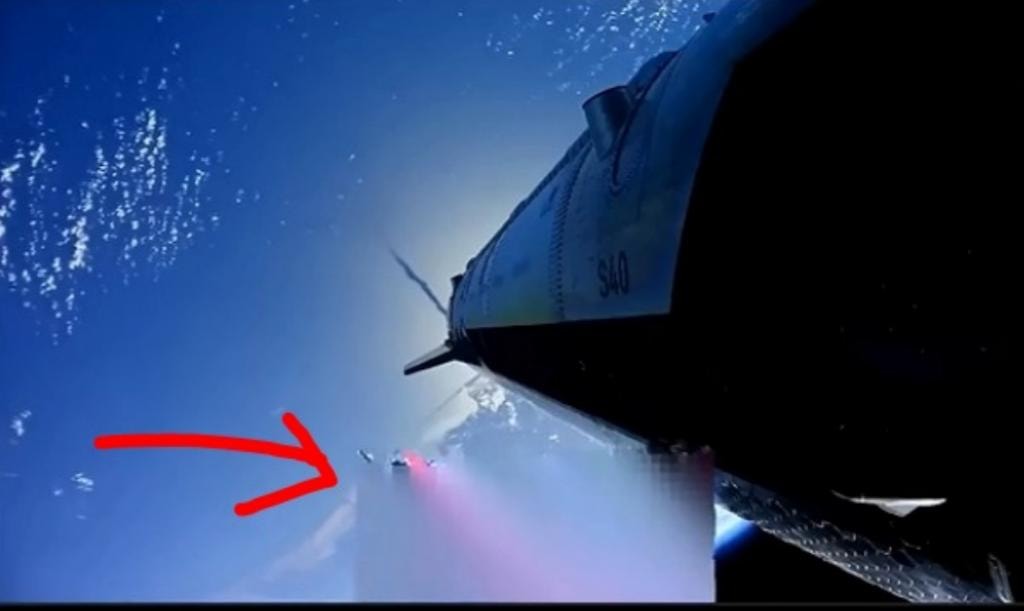
EXHIBIT A — ANNOTATED
Red arrow added by FakeX Livestream Anomaly Division. The red object is not the arrow. The arrow is pointing at the red object. These are two separate red things.
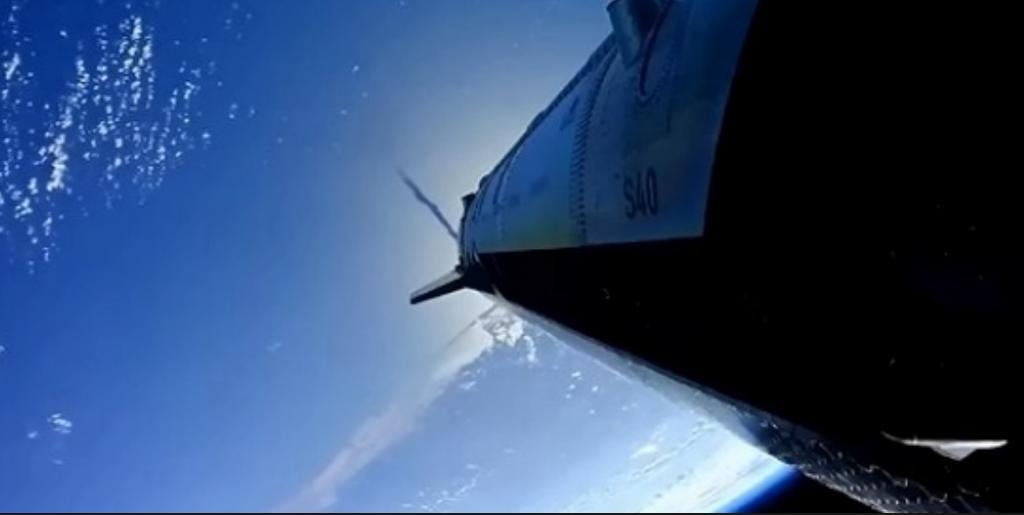
EXHIBIT B — UNANNOTATED
Same frame. No annotation. The object was there. Then it was not there. We are noting this.
THE QUESTION — FORMALLY SUBMITTED — FAKEX LIVESTREAM ANOMALY DIVISION
WHAT WAS THE RED OBJECT?
During the Flight 13 livestream, a small red object — or red light — appeared in the footage near the Starship vehicle during ascent. It was visible for a brief period. It was not, as far as we can determine, part of the rocket. It was not, as far as we can determine, a known navigation light, engine exhaust artefact, or camera lens flare. It appeared. It was red. It left. We would like to know what it was. We are asking SpaceX. We are asking publicly. We are asking on the internet. We are asking on FakeX. We consider this a reasonable question. We await a response.
CANDIDATE EXPLANATIONS — ASSESSED BY FAKEX LIVESTREAM ANOMALY DIVISION — IN ORDER OF LIKELIHOOD
01
LIVESTREAM COMPRESSION ARTEFACT
PLAUSIBLEH.264/H.265 video compression can produce coloured block artefacts, particularly in high-contrast scenes with fast-moving objects against bright backgrounds. A single red macroblock appearing briefly near a bright exhaust plume is consistent with this explanation. This is the boring explanation. We are noting it first because we are a serious organisation.
02
LENS FLARE OR INTERNAL REFLECTION
PLAUSIBLECamera optics produce internal reflections when pointed at bright light sources. The Raptor engine exhaust is extremely bright. A red internal reflection from a lens element is physically possible. This is also a boring explanation. We are noting it.
03
DEBRIS FROM THE VEHICLE
POSSIBLESmall pieces of thermal protection material, insulation, or other components have been observed separating from launch vehicles during ascent. A fragment catching sunlight at a particular angle could appear red or orange. This would be less boring. We are noting it.
04
SOMETHING ELSE ENTIRELY
UNCONFIRMEDWe are not specifying what "something else entirely" means. We are simply noting that the above explanations are candidate explanations, not confirmed explanations. The object appeared. It was red. It left. We have submitted the question. We are waiting. We remain available for comment. We have a laminated Post-it note and we are not afraid to use it.
FAKEX LIVESTREAM ANOMALY DIVISION — OFFICIAL POSITION — FOR THE RECORD
We do not know what the red object was. We are asking. We have asked on the internet. We have asked on FakeX. We have not yet asked SpaceX directly because we do not have their email address. We have the email address for the Smithsonian Institution (they replied once, about the Moon buggy, to say it was folded). We do not have SpaceX's email address. If anyone has SpaceX's email address and would like to forward our question, we would be grateful. The question is: what was the red object in the Flight 13 livestream. That is the whole question. We await a response. We are noting this in the minutes. The minutes are on the fridge. There is still room.
FAKEX COMPETITIVE INTELLIGENCE UNIT — OFFICIAL VERDICT — FLIGHT 13
ROCKET SIZE
VERY LARGE
Noted. Acknowledged. Still exploded.
DEBRIS SPEED
"SLOW"
1,000mph. Concorde speed. "Slow." We are still thinking about this.
OVERALL RATING
MUST DO BETTER
The arms are impressive. The explosion is not. Do better.
COMPETITIVE INTELLIGENCE UNIT — INTERNAL NOTE — THE LAWNMOWER UPDATE
The lawnmower on the Warwick Road has gone. We checked on Tuesday. The skip has been collected. The lawnmower was in the skip. The skip and the lawnmower are now, presumably, at a waste processing facility in the West Midlands. We are disappointed. It was a Flymo. It had potential. We have identified a replacement candidate — a petrol strimmer in a garden on Leamington Road — but the owner appears to be using it, which complicates the acquisition process. We are monitoring the situation. We remain committed to the 3.3-Stage Rocket programme. We have not given up. We have never given up. We have 23 funding rejections and we have not given up. SpaceX has $3 billion and they are distributing their rocket over the Caribbean at 1,000 miles per hour. We feel we are, in the circumstances, doing reasonably well.
The 3.3-Stage Rocket remains on the picnic table. It has not been investigated by the FAA. We consider this a point in its favour.